


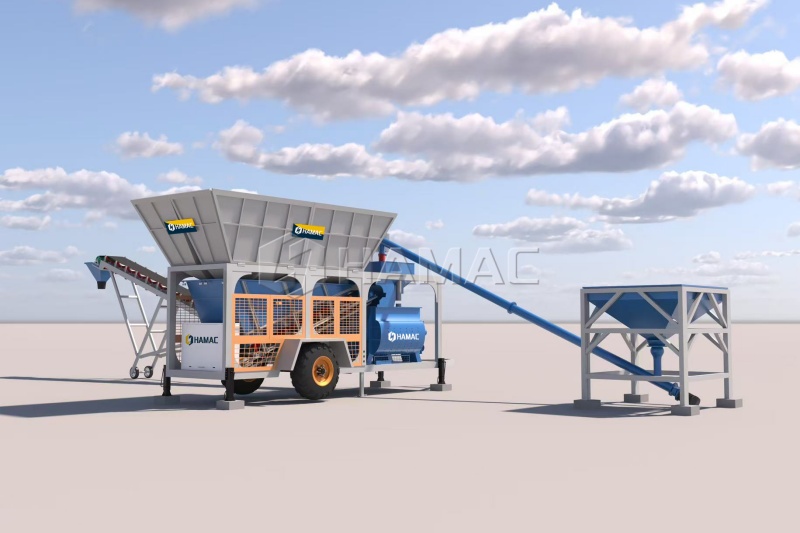
Is a mobile concrete batching plant better than a stationary plant?
Source: Hamac Machinery
A mobile concrete batching plant is not always better than a stationary plant. It is usually the better choice when a contractor needs on-site concrete production, easier relocation, and a compact equipment arrangement. A stationary concrete batching plant is generally better for a permanent ready-mix business, long-term centralized production, and projects that require substantial material storage or future expansion. The right choice depends on how the plant will be used, not simply whether it is mobile or fixed.
When comparing a mobile concrete batching plant vs. a stationary plant, buyers often focus on hourly capacity and purchase price. However, project duration, relocation frequency, raw-material supply, installation conditions, and concrete delivery logistics can be equally important. A plant with a lower initial quotation may not deliver the lowest overall cost if it requires expensive site preparation, causes production interruptions, or is difficult to move to the next project.
HAMAC offers both mobile concrete batching plants and stationary concrete batching plants. Understanding their practical differences helps contractors and concrete producers choose a configuration that matches actual demand, site conditions, and long-term business plans.
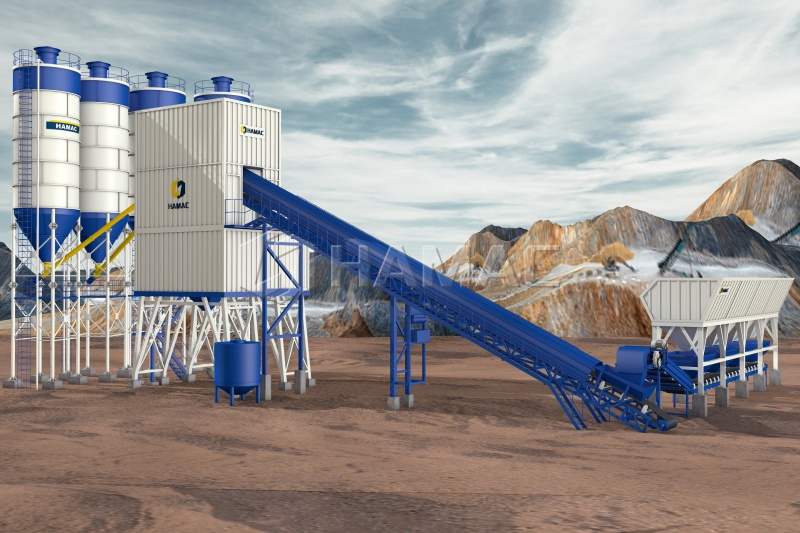
Stationary concrete batching plant
What Is the Difference Between a Mobile and a Stationary Concrete Batching Plant?
Both plant types can weigh materials, transfer ingredients, mix concrete, and discharge the finished batch. The main difference is how the equipment is arranged and how easily the installation can be relocated. A mobile concrete batching plant integrates key production systems into a compact, transport-oriented structure. A stationary concrete batching plant is assembled around a fixed site layout, allowing the installation to be developed around long-term production requirements.
A portable concrete batching plant can simplify deployment between construction sites. However, the complete installation may still include transported cement silos, screw conveyors, loading ramps, and auxiliary equipment. Buyers should confirm the transport plan for the entire system rather than assuming that every component travels with the main mobile unit. Similarly, a stationary plant can be dismantled and relocated, but the work may involve new foundations, substantial assembly, and recommissioning.
| Comparison Factor | Mobile Concrete Batching Plant | Stationary Concrete Batching Plant |
|---|---|---|
| Main Advantage | Easier deployment and relocation between suitable project sites. | A fixed layout designed around long-term production requirements. |
| Typical Application | Temporary construction, roads, bridges, and remote on-site production. | Permanent ready-mix operations and long-term concrete supply. |
| Installation | Integrated modules can reduce assembly work, subject to site preparation and auxiliary equipment. | Usually requires more site-specific assembly and civil works. |
| Material Storage | Storage capacity and replenishment frequency must suit the compact layout. | Often provides greater flexibility for larger storage systems and additional materials. |
| Relocation | Generally easier, but dismantling, transport, and recommissioning still require planning. | Possible, but usually involves more work than a transport-oriented installation. |
| Concrete Quality | Depends on batching accuracy, mixing performance, material control, and operation. | Depends on the same quality-control factors, not the fixed layout alone. |
Mobility does not automatically determine concrete quality. A properly configured mobile plant can produce ready-mix concrete when its weighing systems, mixer, material controls, and operating procedures meet the required specifications. A stationary plant is not protected from inconsistent production simply because it occupies a permanent site. Buyers should compare the production equipment and quality-control arrangements rather than assuming that one plant type always produces stronger concrete.
Concrete batching plant installation requirements also need careful checking. “Mobile” does not necessarily mean “no foundation” or “ready to operate immediately after delivery.” Ground conditions, plant supports, silo foundations, drainage, electrical connections, and local approvals must be reviewed for the selected equipment. Request written installation requirements before finalizing the site or promising a production start date.
Which Concrete Batching Plant Is Better for Your Project?
A mobile concrete batching plant for road construction is worth considering when production needs to follow different work sections and the equipment will be reused on later projects. Similar conditions apply to bridge construction, remote industrial facilities, and temporary infrastructure works. Producing concrete close to the work area can reduce dependence on a distant ready-mix supplier, provided that cement, aggregate, water, power, and trained personnel are available.
For a portable concrete batching plant for remote projects, the main question is not only whether the plant can reach the site. The site must also support reliable production. Cement deliveries, aggregate stockpiles, loader movement, water supply, and concrete discharge routes all require planning. A compact plant will not operate efficiently if raw materials arrive irregularly or the available handling equipment cannot keep pace with production. HAMAC’s mobile concrete batching plant on a mountain jobsite provides a relevant reference for discussing site access and equipment layout.
A stationary concrete batching plant for a ready-mix business is generally a strong option when the operator has a permanent location and plans to supply several nearby construction customers. The fixed site can be organized around aggregate storage, cement deliveries, truck circulation, maintenance access, and regular production. If the business expects to add more cement types, aggregate fractions, or a second production line, an expandable layout becomes especially valuable.
Project duration should not be the only deciding factor. A temporary project with substantial continuous demand may justify a larger stationary or modular installation. A mobile plant can also serve a longer-running operation if its production capability, storage, and site arrangement are appropriate. The selection should reflect the complete operating model rather than a simple rule that all short projects need mobile equipment and all long projects need stationary equipment.
1. Consider a mobile plant when relocation is a recurring requirement, and the installation will serve several construction sites.
2. Consider a stationary plant when the business depends on long-term centralized production and regular deliveries to multiple customers.
3. Compare both options when land is limited, because compact stationary configurations may also fit the available space.
4. Evaluate a relocatable modular system when a major project requires substantial production capacity but a planned move is expected later.
For limited sites, HAMAC’s hoisting hopper concrete batching plant is another configuration to assess. This illustrates why a small site does not automatically require a mobile plant. The feeding method, storage arrangement, discharge height, and vehicle access should be considered together.
As an illustrative example, a contractor working on successive road sections may prioritize easier relocation and on-site production. A ready-mix company supplying several urban construction projects from a permanent yard may prioritize storage, dispatch efficiency, and expansion space. These are planning examples rather than universal rules; the final recommendation should follow the project requirements.
Compare Total Cost, Actual Output, and Installation Requirements Before Buying
A mobile vs stationary batching plant cost comparison should include the complete installed system. Request proposals based on the same concrete output target, mixer specification, material-storage capacity, control functions, and service scope. Otherwise, a lower quotation may exclude cement silos, conveyors, commissioning assistance, or other equipment needed to operate at the destination site.
Include civil works, transport, assembly, utilities, material handling, environmental controls, maintenance, and staffing in the calculation. If the plant will be moved, budget for dismantling, loading, transport permits, installation, calibration, and lost production during the move. A mobile concrete batching plant may reduce relocation effort, but the value of that advantage depends on how often the equipment will actually move.
Capacity requires the same attention. A nominal output rating in cubic meters per hour is not a guaranteed production rate for every concrete mix and operating condition. Mixing time, material replenishment, recipe changes, truck availability, and interruptions can affect actual output. Choose the plant according to peak concrete demand and the complete production cycle. Read HAMAC’s concrete batching plant capacity selection guide for a more detailed discussion.
For overseas projects, provide the destination country, electrical specifications, transport restrictions, site dimensions, and applicable approval requirements. These details help determine whether the proposed plant and its supporting equipment fit the actual location. A country-specific quotation should account for real installation and operating conditions rather than simply changing the destination name on a standard proposal.
Before requesting a mobile concrete batching plant for sale or a stationary plant quotation, prepare the following information:
◽ Required daily concrete volume and peak hourly demand.
◽ Concrete applications, mix requirements, and material types.
◽ Project duration, operating hours, and relocation frequency.
◽ Available land, ground conditions, and delivery access.
◽ Cement and aggregate supply arrangements.
◽ Power, water, concrete transportation, and maintenance resources.
◽ Destination country, service requirements, and future expansion plans.
FAQ
◾ Is a mobile concrete batching plant always cheaper?
No. The purchase price and total project cost depend on the configuration, site preparation, auxiliary equipment, and operating plan. Compare equivalent supply scopes before deciding which option offers better value.
◾ Can a mobile batching plant produce ready-mix concrete?
Yes. A suitably configured mobile plant can produce ready-mix concrete. Confirm the weighing accuracy, mixer performance, material controls, testing procedures, and standards required by your customers or project.
◾ Does a mobile concrete batching plant require a foundation?
The requirements depend on the plant design, silo arrangement, supporting ground, and local rules. Some systems use engineered steel supports or skid arrangements, but site stability and installation conditions still need to be verified.
◾ Can a stationary concrete batching plant be relocated?
Yes, but the process can require substantial dismantling, transport, replacement civil works, installation, and recommissioning. If repeated moves are expected, compare a mobile or purpose-designed relocatable system before purchasing.
◾ Which plant is better for a permanent ready-mix business?
A stationary plant is generally a strong starting point for long-term centralized supply, especially when substantial storage and expansion space are needed. The final choice should still reflect demand, available land, delivery logistics, and the proposed configuration.
The best concrete batching plant is the one that supports your production model throughout its working life. Prioritize mobile equipment when relocation and on-site production offer a practical advantage. Prioritize stationary equipment when permanent production, storage flexibility, and long-term centralized supply matter more. Explore HAMAC concrete production equipment and share your output target, project schedule, and site conditions to discuss a suitable solution.
There is no lowest price, only lower price. You get what you pay for. We hope you are looking for the perfect working performance of the equipment, not the low-priced inferior goods. HAMAC only provide our clients with high quality machines. Wish a cooperation with you in the future.
Tags :
concrete batching plant installation requirements mobile batching plant for road construction mobile concrete batching plant for sale mobile concrete batching plant vs stationary plant portable concrete batching plant for remote projects stationary concrete batching plant for ready mix business stationary vs mobile concrete batching plant