


Both a spider concrete placing boom and a self-climbing concrete placing boom accurately distribute pumped concrete across slabs, walls, columns, and other structural areas. They are typically connected to a trailer concrete pump, stationary concrete pump, or another suitable pumping system. The key difference is how each boom moves as the project progresses. A spider boom is a mobile, flexible solution that can be relocated by a tower crane or other lifting equipment, while a self-climbing boom is designed to rise with the building via a hydraulic climbing system.
For buyers comparing a mobile concrete placing boom with a self-climbing model, the right choice depends on the building height, typical floor area, placing radius, elevator shaft or floor-opening conditions, tower-crane availability, project duration, and concrete pumping arrangement. HAMAC is a China-based manufacturer and supplier of concrete placing booms and concrete pumping equipment for overseas building, commercial, infrastructure, and high-rise construction projects.
Comparison Matrix: Spider vs. Self-Climbing Concrete Placing Booms
The following comparison matrix helps project managers, contractors, and concrete pumping companies identify the best placing boom type before requesting a quotation. Actual specifications, installation requirements, and working radius should always be confirmed according to the selected model, project drawings, structure design, and local safety requirements.
| Comparison Factor | Spider Concrete Placing Boom | Self-Climbing Concrete Placing Boom |
|---|---|---|
| Alternative Name | Mobile concrete placing boom, hydraulic spider placing boom, mobile concrete boom placer | Hydraulic self-climbing placing boom, floor climbing concrete placing boom, elevator shaft placing boom |
| Movement Method | Usually relocated by tower crane or lifting equipment between floors or pouring positions | Climbs upward with a hydraulic climbing frame as building floors are completed |
| Typical Placing Radius | Often selected for approximately 13 m, 15 m, 17 m, or 21 m placing radius, depending on model | Often selected for larger high-rise coverage, such as approximately 21 m to 32 m or more, depending on model |
| Best Project Type | Low-rise and mid-rise buildings, slabs, warehouses, multiple pouring zones, temporary construction work | High-rise residential towers, commercial towers, hotel projects, core-wall structures, large repeated floor pours |
| Installation Location | Floor slab, temporary platform, construction deck, or other approved placing position | Elevator shaft, core area, reserved floor opening, or planned climbing structure |
| Tower-Crane Dependence | Higher when the boom needs to be transferred between floors or work zones | Lower during normal climbing operation because the hydraulic system moves the boom upward |
| Project Preparation | Relatively flexible setup; confirm slab capacity, lifting plan, pump-pipe route, and safe working area | Requires early planning for shaft/opening dimensions, structural anchoring, climbing route, pump pipe, and installation sequence |
| Best Buyer Priority | Fast deployment, mobility, simple relocation, and practical use across multiple work areas | Long-term high-rise efficiency, extensive coverage, repeated standard floors, and reduced tower-crane occupation |
| Typical Long-Tail Keyword | 21m spider concrete placing boom for slab pouring | self-climbing concrete placing boom for high-rise building |
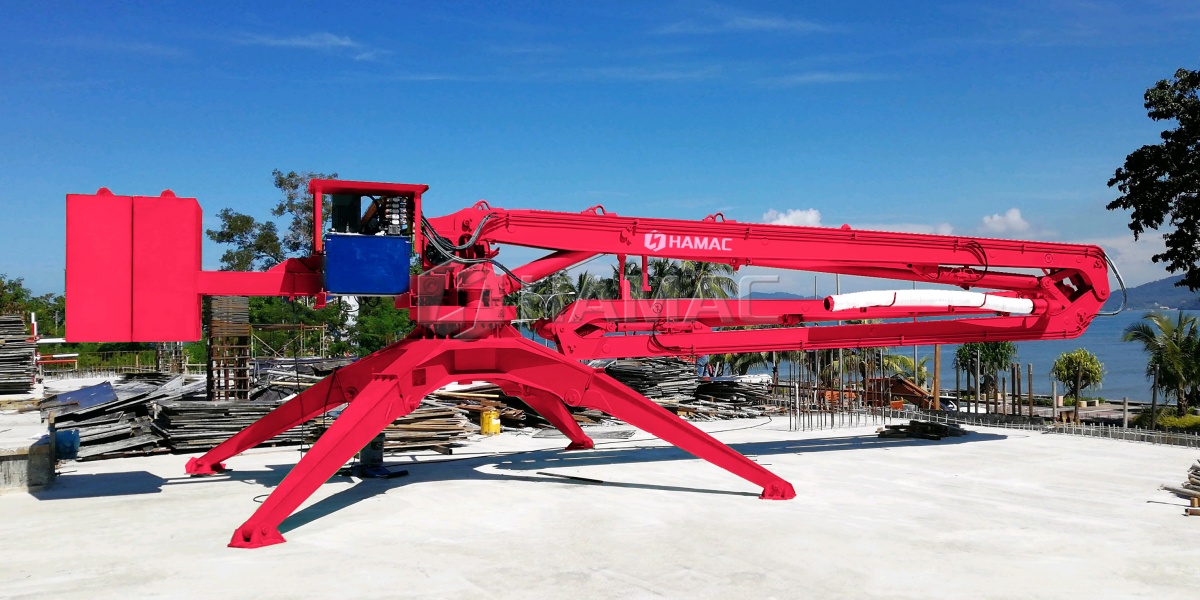
HAMAC provides spider concrete placing boom solutions for mobile floor pouring. Typical models such as 13 m, 15 m, 17 m, and 21 m units can help contractors cover slab and structural pouring areas without repeatedly moving long, heavy concrete pipelines by hand. For high-rise projects, HAMAC also provides self-climbing concrete placing boom solutions designed to rise with the building through a hydraulic climbing system.
Choose a Spider Boom for Mobility or a Self-Climbing Boom for High-Rise Efficiency
A spider concrete placing boom for slab pouring is a practical choice when the construction team needs a compact, mobile, and flexible concrete placing solution. The boom can be installed at a suitable approved location on the slab or construction platform, connected to the pump pipeline, and operated to distribute concrete across the working radius. When the project moves to another level or pouring zone, the boom can normally be transferred by the site lifting plan, often using a tower crane.
This makes a mobile concrete placing boom for residential building projects useful for low-rise and mid-rise apartments, warehouses, commercial floors, foundations, and sites with several separate pouring areas. A 13 m, 15 m, 17 m, or 21 m spider placing boom can be selected according to the floor layout and the required coverage. The buyer should confirm floor loading, boom support arrangement, tower-crane lifting capacity, access for installation, pump pipeline routing, and safe clearance around the work area.
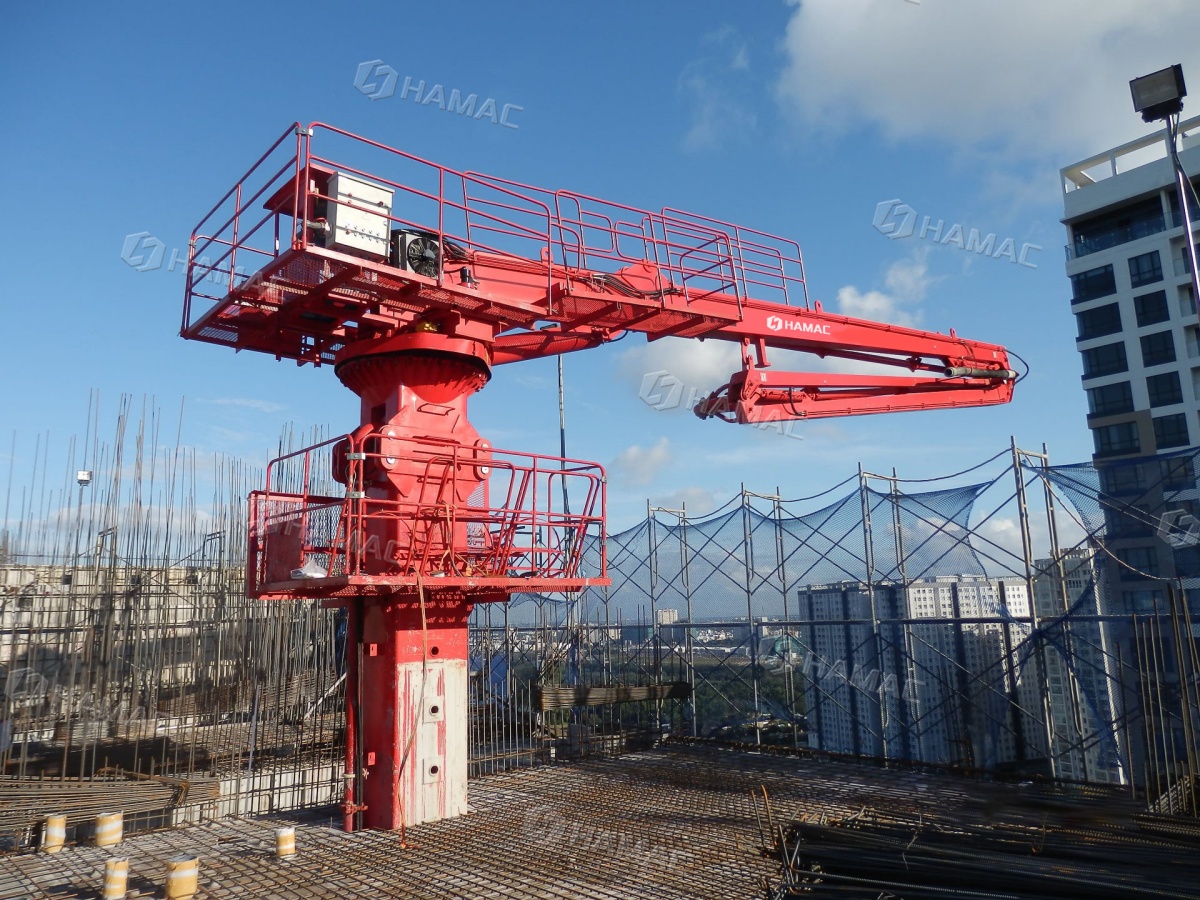
A self-climbing placing boom for elevator shaft is better suited to tall buildings where concrete placement must continue floor after floor. Instead of relying on repeated tower-crane relocation, the hydraulic climbing system moves the boom upward in accordance with the project construction sequence. This can improve workflow for contractors building high-rise residential towers, commercial towers, hotels, hospitals, and core-wall structures with repeated standard floors.
For a self-climbing concrete placing boom for high-rise building projects, early coordination is essential. The construction team should confirm whether an elevator shaft, core area, or reserved floor opening is available; whether the structure can support the installation and climbing loads; how the vertical pump pipeline will be anchored; and how the boom will be installed, climbed, maintained, and removed. A self-climbing system can create strong long-term value when a project has many floors, a large pouring area, and limited tower-crane availability during the main structural phase.
Project Selection Example
A mid-rise residential project with several separate blocks and frequent changes in pouring position may benefit from a mobile spider placing boom. The contractor can use a 17 m or 21 m spider boom with a trailer concrete pump, then lift the boom to the next work area as needed. In contrast, a 30-storey commercial tower with repetitive floor layouts, a usable lift shaft, and a long structural schedule may gain more value from a self-climbing placing boom because the system can climb with the building and reduce repeated tower-crane transfer work.
| Project Condition | Recommended Placing Boom | Why |
|---|---|---|
| Low-rise or mid-rise residential slab pouring | Spider Concrete Placing Boom | Fast setup and flexible movement between slabs or buildings |
| Warehouse, factory floor, basement, or multiple work zones | Spider Concrete Placing Boom | Practical for changing placement positions and crane-assisted relocation |
| High-rise apartment, hotel, or commercial tower | Self-Climbing Concrete Placing Boom | Hydraulic climbing supports repeated floor-by-floor concrete placement |
| Core wall or elevator shaft construction | Self-Climbing Concrete Placing Boom | Can be integrated with planned high-rise structural construction arrangements |
| Short-duration project with no planned shaft/opening installation | Spider Concrete Placing Boom | Lower preparation complexity and flexible deployment |
| Long-duration project with many identical floors | Self-Climbing Concrete Placing Boom | Can reduce crane dependency and improve sustained placing efficiency |
Match the Placing Boom With the Pumping System, Site Plan, and Budget
Both spider and self-climbing booms are placing equipment, not independent concrete-production machines. Match them with the right concrete supply and pumping system. A spider boom works well with a trailer concrete pump for slab pours and medium-height construction. A self-climbing boom is often paired with a high-pressure stationary or trailer pump, vertical pump pipeline, reliable ready-mix supply, and a concrete batching plant arrangement capable of supporting continuous pouring.
- Required placing radius: Measure the real floor coverage, including the boom installation point, wall lines, slab edges, and areas that may require end-hose extension. Select the model from the actual placing radius, not only the total building size.
- Concrete pump output and pressure: The pump must provide enough output for the planned pouring rate and enough pressure to overcome vertical height, pipeline length, bends, reducers, and the concrete mix condition.
- Concrete supply continuity: A placing boom works efficiently only when concrete arrives consistently. Match the system with a batching plant, transit mixer fleet, or on-site mixing arrangement that can support the required pour.
- Site structure and installation plan: Spider booms require a verified placing location and lifting plan. Self-climbing booms require early coordination with the elevator shaft, core, floor openings, structure capacity, and climbing sequence.
- Tower-crane utilization: Calculate how often a spider boom needs crane transfer and whether this may affect other lifting tasks. For high-rise projects, compare this impact with the added preparation and equipment cost of a self-climbing system.
- Total operating value: Compare equipment price, installation, transport, crane time, labor, project duration, spare parts, hydraulic maintenance, and expected reuse on future projects instead of comparing only the initial quotation.
For overseas projects, it is useful to provide the supplier with the building height, typical floor plan, required placing radius, concrete pump model, pump pipeline route, expected pouring volume, tower-crane availability, lift-shaft or floor-opening condition, project schedule, and destination country. This information helps HAMAC recommend a suitable concrete placing boom configuration for projects in Latin America, Africa, Southeast Asia, the Middle East, and other international construction markets. HAMAC has a documented HGY33 self-climbing concrete placing boom project in Chile, which can serve as a relevant reference for high-rise placing-boom inquiries.
In summary, choose a spider concrete placing boom for mobility, faster deployment, crane-assisted relocation, and flexible floor pouring. Choose a self-climbing concrete placing boom for high-rise construction, large floor coverage, repetitive standard floors, and long-term efficiency where the project structure can support a planned hydraulic climbing system.