


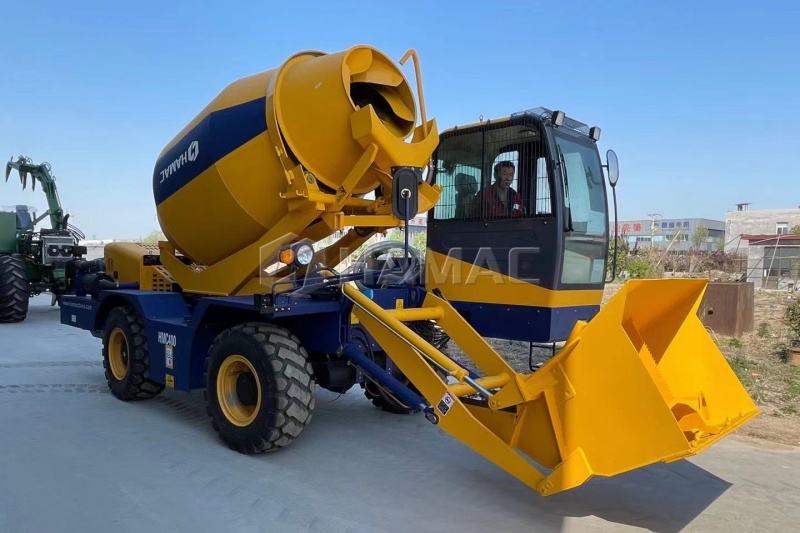
Self-Loading Concrete Mixer vs. Transit Mixer: Key Differences
Source: Hamac Machinery
A self-loading concrete mixer and a transit mixer serve different roles in the concrete supply process. A self-loading concrete mixer combines material loading, batching functions, mixing, short-distance transportation, and discharge in one machine. A transit mixer, commonly called a concrete mixer truck, primarily connects a concrete batching plant with the construction site by transporting and discharging concrete. Depending on the production method, it may also complete mixing inside the drum rather than simply agitating previously mixed concrete.
The main question in a self-loading concrete mixer vs transit mixer comparison is therefore not which machine is universally better. It is whether your project needs to produce concrete at the worksite or transport concrete from an established production facility. Remote housing projects, rural road construction, and dispersed small pours may benefit from on-site mixing. Ready-mix producers supplying several customers typically need a coordinated batching plant and transit mixer fleet.
This guide compares loading methods, mixing functions, actual output, terrain suitability, and operating costs. You can also review the HAMAC self-loading concrete mixer to understand the equipment’s operating sequence before evaluating a model.
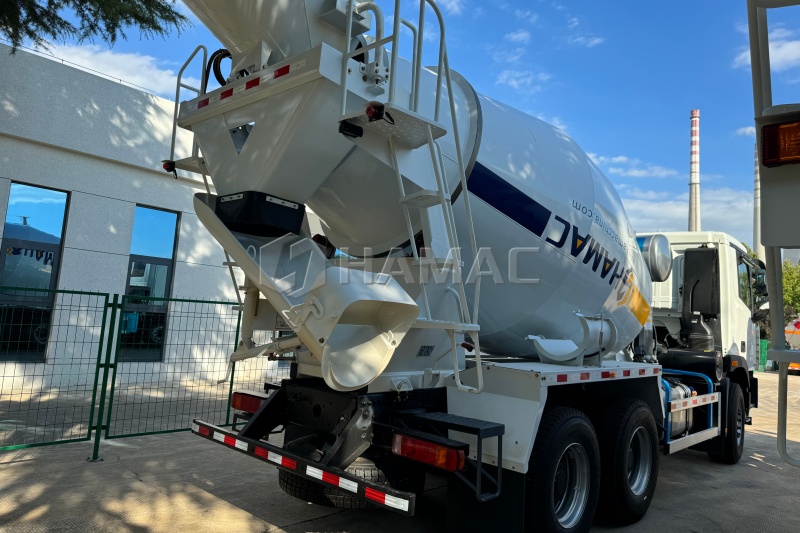
transit mixer
1. Self-Loading Concrete Mixer vs Transit Mixer: Main Functional Differences
A self-loading concrete mixer uses its loading bucket to collect suitable materials from nearby stockpiles. Materials are introduced according to the selected mix design, mixed in the drum, and discharged at the required location. Water supply, weighing equipment, cement feeding, and other functions vary by model and configuration, so buyers should confirm exactly what is included. The machine reduces the need to coordinate separate loading, mixing, and short-distance concrete transport equipment, but it still requires organized material storage, water, fuel, maintenance, and trained operation.
A transit mixer receives material from a concrete production facility. In a central-mixed operation, it carries concrete that has already been mixed and keeps it agitated during transport. In a truck-mixed operation, ingredients are batched at the plant, and the truck drum completes the mixing process according to the applicable procedure. Some operations combine plant mixing with final mixing in the truck. For this reason, saying that a transit mixer “cannot mix concrete” would be inaccurate.
The practical difference is independence from a separate production facility. A self-loading mixer can prepare concrete near the pouring area when the required ingredients and controls are available. A transit mixer normally depends on an external batching and loading system, but it is suited to organized deliveries between that system and one or more construction sites.
| Comparison Factor | Self-Loading Concrete Mixer | Transit Mixer |
|---|---|---|
| Main Role | Produce concrete on site and move it within the working area. | Transport concrete or batched ingredients between a production facility and the jobsite. |
| Material Loading | Uses an integrated bucket for suitable materials; cement and water feeding arrangements depend on configuration. | Receives concrete or measured ingredients from a batching and loading facility. |
| Mixing Function | Mixes concrete in its drum using materials prepared at the site. | Agitates or mixes concrete according to the production method and operating procedure. |
| Supply Requirements | Needs raw materials, water, fuel, suitable stockpiles, and material control at the worksite. | Needs a reliable batching plant or loading source and coordinated delivery scheduling. |
| Typical Application | Remote construction, rural roads, dispersed pours, and small-to-medium on-site production. | Ready-mix delivery, multi-customer distribution, and scheduled concrete supply. |
| Output Calculation | Usable batch output multiplied by actual completed cycles. | Permitted delivery volume multiplied by completed trips, coordinated across the fleet. |
| Main Selection Focus | Batching control, loading efficiency, site mobility, and actual production cycle. | Payload, transport distance, delivery time, discharge conditions, and fleet utilization. |
Concrete quality should not be judged by the vehicle category alone. Both solutions require suitable materials, accurate proportions, controlled water addition, adequate mixing, and testing appropriate to the project. A self-loading mixer does not automatically provide every quality-control function of a fully equipped batching plant. Likewise, a transit mixer cannot correct poorly batched concrete simply by rotating its drum. The equipment and operating process must meet the project’s specified concrete requirements.
When comparing quotations, check whether weighing equipment, water metering, reporting functions, and other requested accessories are included in the proposed configuration.
2. Which Concrete Mixer Is Better for Your Project?
A self-loading concrete mixer for remote construction is worth evaluating when ready-mix delivery is unavailable, expensive, or difficult to coordinate. Typical examples include rural houses, drainage channels, agricultural facilities, road repairs, and projects spread across several small work areas. Producing concrete near the pouring point can make scheduling more flexible, provided that the site can support reliable raw-material supply and controlled production.
For rural road construction, the machine may load materials near a stockpile, mix a batch, and travel to the current work section. However, the distance between the materials and pouring point matters. Long travel distances reduce the number of batches completed during a shift. Frequent relocation of stockpiles, waiting for cement or water, and difficult loading conditions can also limit production. The expected daily output should therefore be calculated from the actual site arrangement rather than a catalog figure alone.
A 4×4 self-loading concrete mixer may be useful on uneven construction access routes, but four-wheel drive does not guarantee suitability for every slope or ground condition. Confirm the selected model’s operating limits, loaded stability, turning requirements, braking performance, and tire configuration. Road registration and transport arrangements must also be checked locally; a site-oriented machine should not automatically be treated as a substitute for a road-going delivery truck.
HAMAC has documented an HMC400 self-loading concrete mixer delivery to Peru. The delivery reference can help buyers discuss configuration and overseas supply requirements, but it should not be interpreted as a guarantee of output or performance under different project conditions.
A transit mixer for ready-mix concrete delivery is usually the stronger option when production is organized at a batching plant and the main task is distribution. A ready-mix company may need to serve several customers, maintain scheduled deliveries, and supply a pump continuously during a large pour. In that situation, the plant, dispatch team, trucks, and jobsite must operate as a coordinated system. Individual truck capacity is only one part of the overall delivery capability.
For a large foundation or commercial floor slab, continuous supply may require several transit mixers operating in rotation. The required fleet depends on loading time, road travel, traffic, site queuing, unloading, and the return journey. Adding trucks will not solve a bottleneck if the batching plant cannot load them quickly enough or if the site cannot receive and discharge concrete efficiently.
| Project Condition | Option to Evaluate First | Main Reason |
|---|---|---|
| Remote worksite without dependable ready-mix delivery | Self-loading concrete mixer | Allows concrete preparation near the work area when suitable materials and controls are available. |
| Several small pours across a rural construction site | Self-loading concrete mixer | Combines batch production and local movement in one machine. |
| Ready-mix company supplying multiple customers | Transit mixer fleet | Supports coordinated distribution from a central production facility. |
| Large continuous pour with dependable plant supply | Batching plant and transit mixer fleet | Allows production and transport capacity to be planned around the required delivery rate. |
| Restricted access, slopes, or weak ground | Site-specific equipment assessment | Vehicle dimensions, loaded weight, stability, and operating limits must be verified. |
If your business already owns a stationary concrete batching plant, the decision may focus on matching delivery vehicles to production and customer demand. If no production facility is available, compare the complete cost of on-site mixing with the cost and reliability of purchased ready-mix concrete. These are different supply models, so comparing only the prices of the two vehicles can be misleading.
3. Compare Actual Output, Operating Cost, and Buying Requirements
The correct capacity comparison starts with usable concrete output, not drum size alone. Drum geometric volume, rated concrete output per batch, and permitted vehicle payload are different specifications. Buyers should ask suppliers to identify the meaning of each capacity figure rather than assuming that the full drum volume is usable concrete capacity.
For a self-loading mixer, estimate daily production by multiplying the usable output per batch by the number of completed batches. The cycle should include loading, measuring, mixing, travel, positioning, discharge, and necessary cleaning or preparation. For a transit mixer, estimate delivered volume from the permitted load per trip and the number of completed trips. A fleet calculation must also account for the batching plant’s loading capacity and the site’s receiving rate.
As an illustrative planning example, a machine producing 3 m³ of usable concrete per batch and completing eight full cycles would produce 24 m³ during that period. A delivery truck carrying 8 m³ per trip and completing three trips would also deliver 24 m³. These figures are examples, not equipment performance claims. They demonstrate why cycle time, delivery distance, and work organization matter as much as nominal capacity.
When comparing self-loading mixer vs. transit mixer cost, calculate the cost of concrete reaching the pouring point. A self-loading operation must account for raw materials, loading and batching work, fuel, labor, testing, maintenance, and site preparation. A transit mixer operation must account for plant production or purchased concrete, transport, dispatch, waiting time, vehicle maintenance, and unloading arrangements. If a batching plant is not already available, include that production source in the overall investment assessment.
◾ Equipment investment: Compare the full configuration, delivery scope, and required supporting equipment.
◾ Material costs: Include cement, aggregate, water, admixtures, losses, and material handling where on-site production is planned.
◾ Fuel and labor: Use the expected working cycle and operating hours rather than an unsupported fixed consumption figure.
◾ Transport and waiting: Consider the route, traffic, site access, unloading time, and distance between stockpiles and pouring areas.
◾ Maintenance: Review drum cleaning, hydraulic servicing, tires, filters, drivetrain components, and spare-parts support.
◾ Quality management: Include batching control, material checks, testing, and personnel responsibilities.
◾ Utilization: Estimate how often the equipment will work and whether it can be used profitably after the current project.
For overseas buyers, destination-specific requirements should be part of the inquiry. Provide local road restrictions, applicable registration rules, emission requirements, service availability, and the intended operating environment. A concrete mixer for a narrow rural site may need a different configuration from a road-going vehicle delivering concrete between an urban batching plant and multiple construction sites.
FAQ
Can a transit mixer mix concrete, or does it only transport it?
A transit mixer can mix or agitate concrete depending on the production method. Central-mixed concrete is generally agitated during transport, while truck-mixed concrete is mixed inside the drum using ingredients batched at the plant. Follow the applicable mix procedure, equipment instructions, and project standards.
Can a self-loading concrete mixer replace a batching plant and transit mixer?
It can provide an alternative supply method for suitable projects by combining loading, mixing, and local transport. However, it is not a universal replacement for a batching plant and delivery fleet. Required output, quality controls, material storage, transport distance, and continuous-pour requirements must be assessed.
Which mixer is better for remote construction sites?
A self-loading mixer is often worth evaluating where ready-mix delivery is unreliable and raw materials can be supplied to the site. If a nearby project batching plant can provide stable concrete supply, transit mixers may still be practical. The complete supply arrangement determines the better option.
How do you calculate actual daily output?
For a self-loading mixer, multiply usable batch output by realistic completed cycles. For a transit mixer, multiply permitted delivery volume by completed trips and coordinate this with fleet size, plant loading capacity, and site discharge capacity. Include delays and normal operating interruptions in both calculations.
What information is needed to select the right concrete mixer?
Provide daily concrete demand, peak pouring rate, concrete specifications, material source, transport distance, terrain, access dimensions, available production equipment, working hours, and destination country. State whether the equipment will mainly produce concrete on site or deliver it from a batching plant.
Choose a self-loading concrete mixer when controlled on-site production and local mobility solve a genuine supply problem. Choose a transit mixer when the main requirement is dependable delivery from a batching facility. To discuss a suitable configuration, explore HAMAC concrete equipment and share your production target, travel distance, site conditions, and intended operating method.
There is no lowest price, only lower price. You get what you pay for. We hope you are looking for the perfect working performance of the equipment, not the low-priced inferior goods. HAMAC only provide our clients with high quality machines. Wish a cooperation with you in the future.
Tags :
concrete mixer for rural road construction concrete mixer truck for batching plant self-loading concrete mixer for remote construction self-loading concrete mixer operating cost self-loading concrete mixer vs transit mixer self-loading mixer vs concrete mixer truck transit mixer for ready-mix concrete delivery
Next :
Sorry,This is the last Page!