


A truck-mounted concrete boom pump for sale is designed for projects that require fast, accurate, and high-efficiency concrete placement. By combining a concrete pumping unit, hydraulic boom, delivery pipeline, and truck chassis in one machine, a concrete boom pump truck can travel directly to the project, deploy quickly, and deliver concrete to elevated or hard-to-reach pouring areas. It is widely used for high-rise buildings, commercial complexes, bridges, foundations, industrial plants, and infrastructure projects.
When choosing a concrete pump truck for sale, buyers should not focus only on boom length or initial price. The right model depends on the required placing reach, concrete output, pumping pressure, site access, chassis configuration, concrete supply capacity, and local maintenance conditions. HAMAC provides truck-mounted concrete boom pump solutions with boom lengths from about 30 m to 70 m to meet different project requirements.
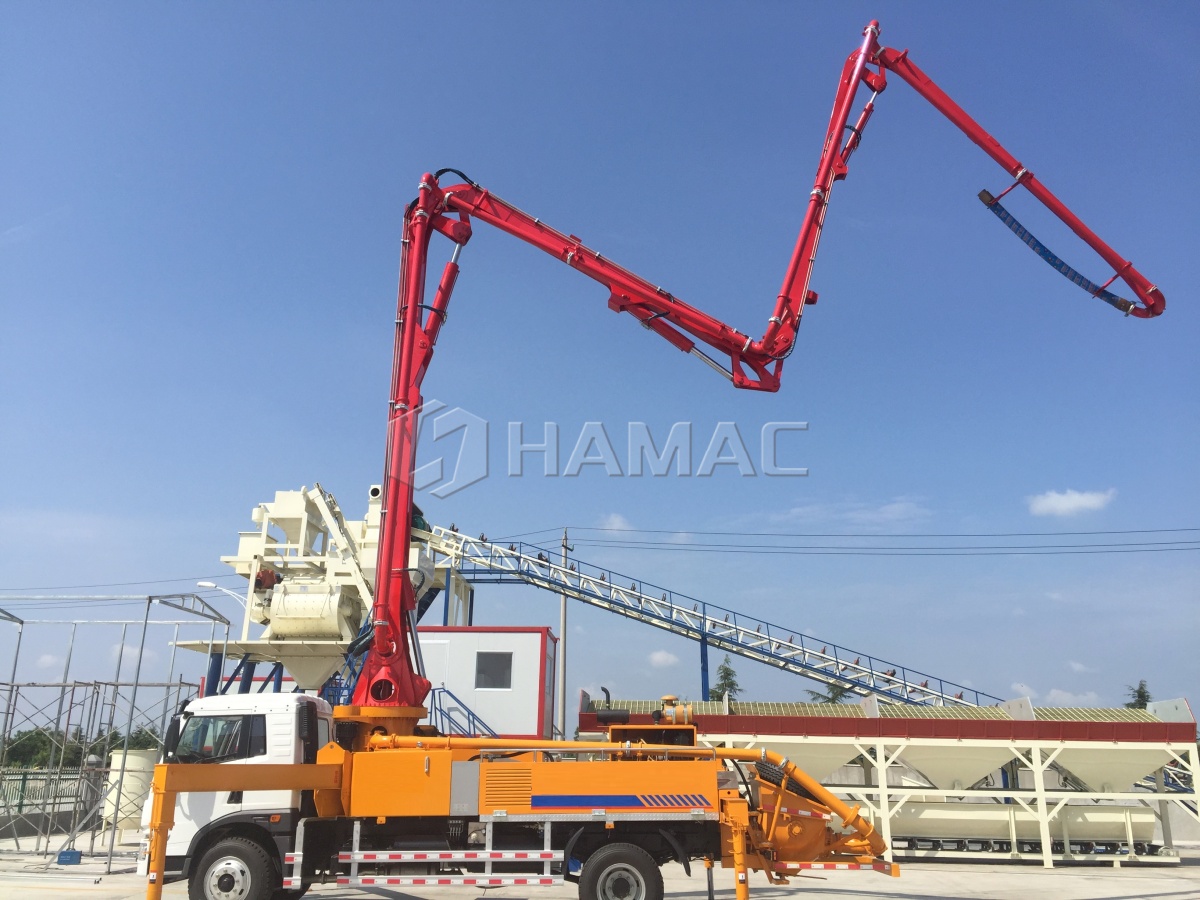
Choose the Right Boom Length, Output, and Pumping Reach
The boom length is one of the first specifications buyers compare when searching for a concrete boom pump truck. Common options include 30 m, 38 m, 42 m, 47 m, 52 m, 56 m, 63 m, and longer booms for demanding projects. However, select the boom length based on the actual working coverage, not just the building height. The pump truck parking position, distance from the structure, boom folding design, obstacles, and required pouring area all affect the usable reach.
A 30 m or 38 m concrete pump truck can be suitable for villas, low-rise residential buildings, factory floors, and compact construction sites. A 42 m or 47 m concrete boom pump often provides a practical balance for medium-rise residential and commercial projects. For high-rise buildings, large floor slabs, and complex infrastructure work, a 52 m, 56 m, 63 m, or longer boom may be required. Before ordering, provide the supplier with building drawings, expected parking position, vertical height, horizontal reach, and site access information.
| Typical Boom Length | Suitable Project Type | Buyer Focus | Long-Tail Search Keyword |
|---|---|---|---|
| 30–38 m | Villas, low-rise buildings, foundations, small commercial projects | Compact size, site access, practical investment | 30m concrete pump truck for sale |
| 42–47 m | Mid-rise apartments, commercial buildings, bridges | Balanced reach, efficient concrete placing, flexible operation | 47m concrete boom pump truck |
| 52–56 m | High-rise residential projects, large commercial structures | Working coverage, outrigger space, chassis capacity | 56m concrete pump truck for high-rise building |
| 60–70 m | Large infrastructure, major high-rise projects, wide-area pouring | Site planning, transport routes, support surface, trained operator | Long boom concrete pump truck manufacturer China |
In addition to boom reach, confirm the required concrete pump output and pumping pressure. Output is usually measured in cubic meters per hour and should match the peak pouring demand. Pumping pressure is especially important when concrete must travel through long pipelines, reach upper floors, pass through multiple bends, or use a demanding concrete mix. A large boom pump should also be matched with a stable concrete batching plant supply and enough concrete mixer trucks to avoid pumping interruptions.
Check the Chassis, Pumping System, and Jobsite Configuration
A truck-mounted concrete pump is a complete mobile system. The truck chassis carries the boom, pumping unit, hydraulic components, outriggers, and delivery pipeline. Therefore, the chassis must suit local road conditions, transport regulations, axle-load limits, and the availability of maintenance support. Buyers exporting a concrete pump truck should also confirm driving side requirements, local registration rules, emission standards, and whether spare parts for the selected chassis are accessible in the destination market.
The pumping unit should be evaluated by its hydraulic system, distribution valve, pumping cylinders, hopper design, cooling system, automatic lubrication, remote control, and maintenance access. For a concrete pumping company or equipment rental business, reliable daily operation is more valuable than selecting a lower-priced unit with unclear wear-part support. Ask the supplier about the recommended spare-parts package, including pipeline components, seals, delivery cylinders, wear plates, cutting rings, clamps, and filters.
- Truck chassis: Confirm chassis brand, axle configuration, engine power, road compliance, and local service availability before finalizing the concrete pump truck configuration.
- Boom and outrigger system: Check boom folding type, boom section design, outrigger span, automatic leveling, and the available space for safe setup at your normal job sites.
- Pumping system: Compare nominal output, maximum pumping pressure, concrete cylinder size, hopper capacity, hydraulic cooling, and distribution valve configuration.
- Concrete mix compatibility: Confirm maximum aggregate size, recommended slump range, and normal mix-design requirements to reduce the risk of blockage and unstable pumping.
- Control and safety equipment: Check remote control functions, emergency stop system, safety interlocks, boom monitoring, lighting, and alarm functions.
- Service and spare parts: Request a wear-parts list, maintenance schedule, operating manual, technical support plan, and recommended spare-parts package for the first operating period.
Before the pump truck arrives, confirm that the jobsite has a stable parking area, enough space for outriggers, safe access for concrete mixer trucks, and no overhead obstacles. Concrete placing equipment safety guidance highlights the importance of considering ground conditions, outriggers, overhead power lines, traffic movement, and worker separation during setup and operation. Site conditions should be reviewed according to local regulations, the equipment operating manual, and the project’s safety procedures.
Compare Total Cost, Safety, and Long-Term Concrete Pumping Value
The concrete boom pump truck price is influenced by boom length, pumping capacity, maximum pressure, chassis brand, axle arrangement, hydraulic configuration, control system, emission requirements, included accessories, spare parts, and service scope. For this reason, buyers should compare complete quotations with the same configuration basis. A lower initial quotation may exclude essential pipeline accessories, commissioning support, spare parts, or configuration items needed for the destination market.
For long-term operation, calculate the total cost of ownership rather than only the purchase price. Consider fuel consumption, maintenance intervals, hydraulic oil and filter replacement, wear-part consumption, operator training, insurance, registration, transport compliance, and expected utilization rate. A reliable concrete boom pump truck can create value by reducing manual pipeline movement, accelerating the pouring schedule, and supporting higher-value pumping services for ready-mix and construction customers.
Example: Boom Pump Selection for a High-Rise Residential Project
A contractor is building several residential towers and needs to pour slabs, columns, and shear walls on a strict schedule. Instead of selecting a pump truck based only on building height, the contractor should evaluate the normal parking location, distance from the truck to the structure, required boom reach, planned concrete volume per hour, number of mixer trucks, batching plant capacity, and available support area for outriggers. A correctly configured concrete boom pump for high-rise construction helps maintain continuous concrete delivery while improving jobsite organization.
For projects that require a wider placing range or fixed high-rise concrete delivery, a concrete placing boom can also be considered. For remote sites or projects where a truck-mounted boom pump is not necessary, a trailer concrete pump or trailer concrete mixer pump may provide a more economical concrete pumping solution.