

 HAMAC Showcases Group Strength and Concrete Solutions at EXCON 2026
HAMAC Wishes You a Happy Mid-Autumn Festival
HAMAC Trailer Concrete Mixer Pump for Foundation Construction in Peru
Source: Hamac Machinery
Foundation construction requires careful coordination between reinforcement installation, formwork preparation, concrete supply and placement. At this construction site in Peru, the work area contains multiple reinforced foundation sections, vertical steel reinforcement cages and prepared formwork. A trailer concrete mixer pump is positioned near the excavation area, while a concrete delivery pipeline extends from the equipment toward the construction zone. This arrangement provides a practical example of how concrete mixing and pumping equipment can support foundation work where concrete needs to be delivered from the equipment location to different placement areas.
For projects involving several foundation sections, organizing concrete supply is an important part of the construction process. The concrete must be prepared according to the required mix design, delivered at an appropriate time and discharged where the reinforcement and formwork are ready. When the working area is not convenient for a concrete mixer truck to reach every placement point directly, a pumping system connected to a delivery pipeline can help transport fresh concrete into the required sections. The site photographs from Peru show this type of arrangement, with the equipment placed outside the main foundation area and the pipeline routed across the jobsite.
trailer concrete mixer pump combines two important functions in one machine: concrete mixing and concrete pumping. Instead of arranging a separate mixer and a separate concrete pump for every operation, contractors can use an integrated machine to prepare concrete and pump it through a pipeline. This configuration can simplify equipment coordination and reduce the space needed for separate machines, depending on the project layout and concrete demand. For foundation construction, where concrete placement may take place in several prepared sections, this integrated working arrangement is worth considering.
| Project Overview | |
| Project Location | Peru |
| Main Equipment | Trailer Concrete Mixer Pump |
| Application | Concrete supply for reinforced foundation construction |
| Visible Site Conditions | Excavation, reinforced steel cages, formwork and concrete delivery pipeline |
| Main Working Functions | Concrete mixing, pumping and pipeline delivery |
How a Trailer Concrete Mixer Pump Supports Foundation Work
The first stage of the process is material preparation. Cement, sand, aggregates and water need to be supplied according to the concrete mix design specified for the construction work. The materials are then introduced into the mixing system. Depending on the selected machine configuration, HAMAC trailer concrete mixer pumps can be equipped with a drum mixer or a twin-shaft mixer. These options allow the equipment configuration to be considered according to the project requirements, material characteristics and expected working conditions. The actual mixing arrangement used at a specific site should always be confirmed against the supplied machine configuration.
After the materials are mixed, the prepared concrete is transferred to the pumping system. The pump delivers the concrete through the connected pipeline toward the placement area. This process is particularly relevant to foundation construction because reinforcement cages and formwork can create narrow working spaces. Moving a large concrete delivery vehicle close to every foundation section may not always be practical. A pipeline provides another way to bring the concrete closer to the required point, provided that the pipeline route, support, connection and working pressure are planned correctly.
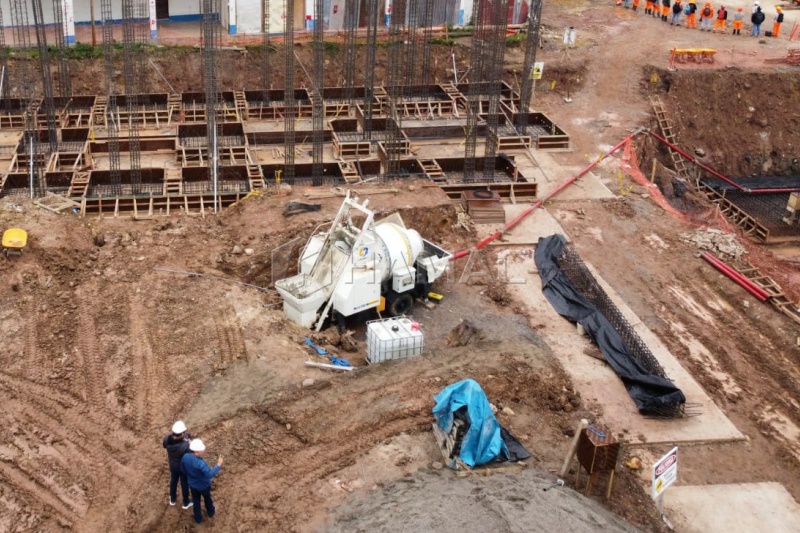
Trailer concrete mixer pump at a foundation construction site in Peru
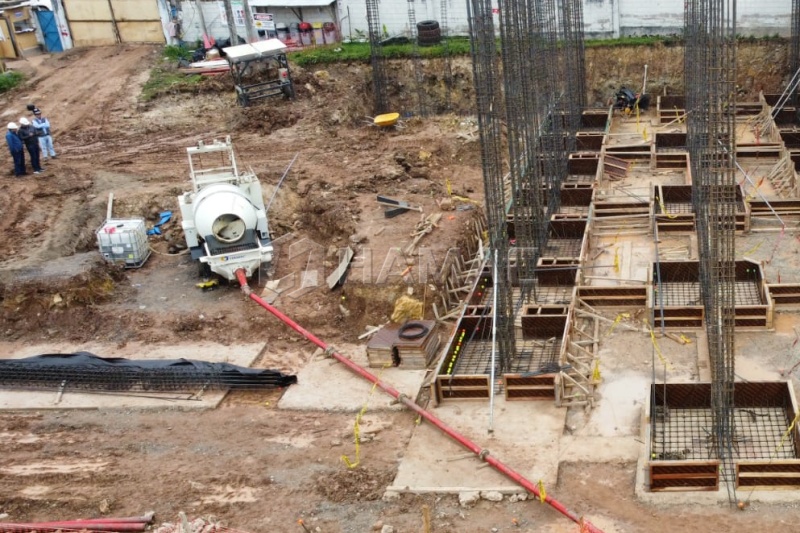
Trailer concrete mixer pump at a foundation construction site in Peru
The red pipeline visible in the photographs is one of the most notable details of the site arrangement. It runs from the equipment area toward the foundation work zone, connecting concrete preparation and placement across the construction site. Before pumping begins, the contractor needs to consider the pipeline route, bends, joints, elevation changes and access for workers. A suitable route can help reduce unnecessary handling and make the concrete delivery process easier to coordinate. The pipeline must also be installed and inspected according to the equipment instructions and the project's safety requirements.
At the discharge end, the construction team receives the concrete and places it into the prepared formwork. The workers need to coordinate the arrival of fresh concrete with the readiness of each section. Reinforcement, formwork dimensions, access paths and the planned pouring sequence all influence how the concrete should be delivered. Once discharged, the concrete may require appropriate distribution, compaction and surface finishing according to the structural design and construction method. The pump supports the delivery stage, while the site crew remains responsible for carrying out the placement operations correctly.
One advantage of an integrated mixer pump is that the mixing and pumping operations can be organized around a single equipment unit. The mixer prepares the concrete while the pumping system transfers the material through the pipeline. This can reduce the need to coordinate two separate main machines and may help make better use of limited working space. It does not remove the need for proper material supply, quality control or skilled operators. Instead, it provides another equipment arrangement for contractors who want to manage concrete preparation and delivery as part of one coordinated process.
| Working Stage | Main Operation | Purpose |
| Feeding | Supply cement, aggregates, sand and water | Prepare materials for concrete production |
| Mixing | Combine materials in the mixing system | Produce fresh concrete according to the mix design |
| Pumping | Transfer concrete into the delivery pipeline | Transport concrete toward the pouring area |
| Placement | Distribute and compact concrete in the formwork | Complete the required foundation concrete work |
HAMAC offers trailer concrete mixer pump configurations with different power and mixing-system options. Depending on the model, the machine may use a diesel engine or an electric motor, while the mixing system may be configured with a drum mixer or a twin-shaft mixer. For projects that require more controlled aggregate and sand proportions, an additional batching system can also be considered. The appropriate configuration depends on the concrete mix design, local power conditions, site access, required output and working schedule. These options should be evaluated during project planning rather than assumed from a site photograph alone.
For a foundation project in Peru, the equipment selection process should start with the actual construction requirements. Contractors should estimate the volume of concrete required for each pour, the number of foundation sections, the distance between the mixer pump and the placement points, and the expected pouring sequence. They should also review the availability of cement, aggregates and water, as well as the ground conditions where the equipment will be positioned. These details influence not only the machine configuration but also the pipeline layout and the way the work area is organized.
The condition of the construction site is another factor to consider. Excavation edges, muddy ground, access roads and other site activities can affect where a trailer concrete mixer pump can be positioned. The equipment should be placed on a suitable, stable working area, with enough space for material feeding, operation, inspection and maintenance. The delivery pipeline should be routed to avoid unnecessary interference with workers and other machinery. A clear work plan helps the operator and construction crew coordinate material preparation, pumping and placement more effectively.
The photographs also highlight the importance of teamwork. Concrete pumping is only one part of the foundation process. Reinforcement workers, formwork teams, equipment operators and concrete placement workers all need to follow the planned construction sequence. If the concrete arrives before the formwork is ready, or if the delivery process is interrupted, the site schedule may be affected. Coordinating the mixer pump with the preparation of each foundation section helps the crew maintain a more organized workflow and use the available working time efficiently.
For contractors comparing different concrete production arrangements, a trailer concrete mixer pump is one option to consider when both mixing and pumping are needed at the site. A separate batching plant and concrete pump may be more suitable for projects with a larger centralized production demand, while an integrated mixer pump may be practical for certain smaller or distributed construction operations. The best choice depends on the project's concrete volume, placement distance, available space, logistics and operating plan. No single configuration is suitable for every construction site.
FAQ
1. What is a trailer concrete mixer pump?
A trailer concrete mixer pump is an integrated machine that combines a concrete mixing system with a pumping system. It prepares fresh concrete and transfers the mixture through a delivery pipeline. This arrangement can reduce the need to organize separate main mixing and pumping machines for certain construction applications.
2. Can a trailer concrete mixer pump be used for foundation construction?
Yes. It can be considered for foundation projects where concrete needs to be prepared and delivered to reinforced sections, bases or prepared formwork. The suitability of the machine depends on the required concrete volume, delivery distance, mix design, site access and construction schedule.
3. Why is a concrete delivery pipeline important?
A delivery pipeline transports fresh concrete from the pump to the required placement area. It can help supply concrete to locations where direct vehicle discharge is difficult. Its route, connections, bends and support points should be planned and inspected before pumping.
4. What is the difference between an integrated mixer pump and separate equipment?
An integrated mixer pump combines mixing and pumping in one machine. A separate arrangement uses an independent mixer or batching plant together with a concrete pump. The integrated option may simplify equipment coordination and save space in certain applications, while a separate production system may be more suitable for larger centralized concrete demand.
5. Can the mixer pump use diesel or electric power?
HAMAC offers diesel-engine and electric-motor configurations, depending on the model. The appropriate option should be selected according to local power availability, project conditions and operating requirements.
6. What should be checked before pumping concrete into a foundation?
The contractor should verify that the reinforcement, formwork and receiving area are ready. The pipeline, joints and supports should also be checked. In addition, the concrete mix, material supply, work sequence and communication between the operator and placement crew should be confirmed.
The trailer concrete mixer pump shown at this construction site in Peru illustrates how integrated mixing and pumping can support concrete delivery for reinforced foundation work. With the equipment positioned near the excavation area and a pipeline routed toward the prepared foundation sections, the site demonstrates the relationship between concrete production, pumping and placement. For contractors planning similar work, selecting the right equipment and arranging the pipeline according to actual site conditions are important steps toward a coordinated concrete construction process.
HAMAC provides trailer concrete mixer pump solutions for projects that require concrete mixing and pumping in one machine. By considering the project layout, required concrete volume, mixing method, power source and delivery route, contractors can identify a configuration that matches their working conditions. From foundation construction to other concrete placement tasks, the objective is to make concrete preparation and delivery easier to organize at the jobsite.
There is no lowest price, only lower price. You get what you pay for. We hope you are looking for the perfect working performance of the equipment, not the low-priced inferior goods. HAMAC only provide our clients with high quality machines. Wish a cooperation with you in the future.
Tags :
trailer concrete mixer pumpHAMAC Concrete Equipmentconcrete mixer pump Peruconcrete pumping for foundation constructionon-site concrete mixing and pumping
dry type batching plant vs wet type batching plantconcrete mortar mixerready mix truckcrushing and screening equipmentconcrete pump transfer case in Rabat
on-site concrete mixing and pumpingDiesel Driven Concrete Pumpconcrete pumpSICOMA Planetary Concrete Mixerplanetary / countercurrent concrete mixer
Next :Sorry,This is the last Page!